Angular.js modules
27 Jan 2014
Public API call angular.module is created by setupModuleLoader function. After removing "irrelevant" code it looks pretty simple. So angular.module is in fact a closure with a modules object in it's lexical environment.
function setupModuleLoader(window) {
    function ensure(obj, name, factory) {
        return obj[name] || (obj[name] = factory());
    }
    var angular = ensure(window, 'angular', Object);
    return ensure(angular, 'module', function() {
        var modules = {};
        return function module(name, requires, configFn) {...}
    }
}
First call to angular.module will create a moduleInstance object and register it in internal modules cache. First argument is a module name, second - module's dependencies (that is another modules), optional third - configuration function. Well, actually second argument is also optional but being called with only one agrument angular.module function has different semantics. If module aaa is already registered than angular.module("aaa") returns cached module object, otherwise it throws error.
// first register modules
angular.module("aaa", []);
angular.module("bbb", []);
angular.module("fff", ["aaa", "bbb"]);

// now we can refer to them by name
var fffModule = angular.module("fff");
Here is 'cleaned up' source code of angular.module:
function module(name, requires, configFn) {
    return ensure(modules, name, function() {
        if (!requires) {
            throw ...;
        }
        var invokeQueue = [];
        var runBlocks = [];
        var config = invokeLater('$injector', 'invoke');

        var moduleInstance = {
            _invokeQueue: invokeQueue,
            _runBlocks: runBlocks,
            ...
        };

        if (configFn) {
            config(configFn);
        }

        return  moduleInstance;
    });
}
Purpose of invokeLater function is to provide mechanism for a deferred function invocation. For example call config(configFn) will put into internal invokeQueue array item that represents deferred function call. Somewhere in the future this information will allow to actually make call.
// now
["$injector", "invoke", configFn]
// in the future
$injector.invoke.apply($injector, configFn)
function invokeLater(provider, method, insertMethod) {
    return function() {
        invokeQueue[insertMethod || 'push']([provider, method, arguments]);
        return moduleInstance;
    };
}
Module instance object has quite a rich API. Everything except run method is using the same pattern with invokeLater and refers to "configuration methods". run method registers callable blocks into internal runBlock array. These blocks will be executed later in the future.
var moduleInstance = {
    provider: invokeLater('$provide', 'provider'),
    factory: invokeLater('$provide', 'factory'),
    service: invokeLater('$provide', 'service'),
    value: invokeLater('$provide', 'value'),
    constant: invokeLater('$provide', 'constant', 'unshift'),
    animation: invokeLater('$animateProvider', 'register'),
    filter: invokeLater('$filterProvider', 'register'),
    controller: invokeLater('$controllerProvider', 'register'),
    directive: invokeLater('$compileProvider', 'directive'),
    config: config,
    run: function(block) {
        runBlocks.push(block);
        return this;
    },
    ...
};
Deferred functions are supposed to be executed by createInjector function. See post about Angular's dependency injection mechanism. loadModules(modulesToLoad) collects runBlocks from all provided modules and their dependencies. Then runBlocks are invoked by the service injector. That's why only services can be injected into runBlocks.
function createInjector(modulesToLoad) {
    ...
    forEach(loadModules(modulesToLoad), function(fn) {
        instanceInjector.invoke(fn || noop);
    });
    ...
}
loadModules is a recursive function that visits modules in topological order. Remember that module can have one or more other modules as their dependencies. Each module's invokeQueue is executed in the "environment" of provider injector. So all configuration methods of module instance object can ask only for providers to be injected. Here is simplified version of loadModules function that nevertheless catches main idea.
function loadModules(modulesToLoad){
    var runBlocks = [], moduleFn, invokeQueue, i, ii;
    forEach(modulesToLoad, function(module) {
        if (loadedModules.get(module)) return;
        loadedModules.put(module, true);
        ...
        moduleFn = angularModule(module);
        runBlocks = runBlocks
                        .concat(loadModules(moduleFn.requires))
                        .concat(moduleFn._runBlocks);

        for(invokeQueue = moduleFn._invokeQueue,
                    i = 0, ii = invokeQueue.length; i < ii; i++) {
            var invokeArgs = invokeQueue[i],
                provider = providerInjector.get(invokeArgs[0]);
            provider[invokeArgs[1]].apply(provider, invokeArgs[2]);
        }
        ...
    });
    return runBlocks;
  }
In the following example (see fiddle) module modA is created. Third argument to angular.module is a configuration function that setups provider for '$shell' service. After everything is setup runBlock provided by run method is executed. It ask for a $shell service.
var ShellProviderFn = function() {
    this.$get = function() {
        return {
            magic_symbol: '@',
            log: function(what) {
                console.log(this.magic_symbol + what);
            }
        };
    };
};

var modAInstance = angular.module("modA", [], function($provide) {
    console.log('begin execute ConfigFn');
    $provide.provider('$shell', ShellProviderFn);
}).run(function($shell) {
    console.log('begin execute runBlock');
    $shell.log('Hello');
});

angular.injector(["modA"]);
Angular.js modules are not for namespaces, but for structuring of application. Many modules may share common injector thus introducing some kind of global space. So if module modA registers a service servA, then any other module that shares with modA the same injector can ask simply for servA.
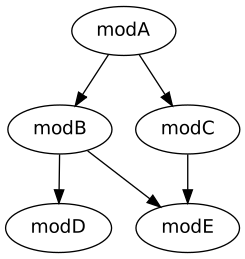
Possible module dependency graph
Typical Angular.js application has one main module that may optionally depend on helper modules that provide some specific functionality. Main module is declared in HTML markup by ng-app attribute. This allows Angular.js to catch up user defined modules and execute them in the context of the same injector that is used be built-in modules.
Here is demo example:
<html ng-app="superApp">
    ...
</html>
var modules, key;

modules = {
    superApp: angular.module('superApp', ['modA', 'modB']),
        modA: angular.module('modA', ['modC']),
        modB: angular.module('modB', []),
        modC: angular.module('modC', ['modB'])
};

for (key in modules) {
    modules[key].config((function() {
      var _key = key;
      return function () {
        console.log("Configuring " + _key);
      };
    })());

    modules[key].run((function() {
      var _key = key;
      return function () {
        console.log("Initializing " + _key);
      };
    })());
}
You will see following console output. It's order perfectly corresponds to module dependency graph.
Configuring modB
Configuring modC
Configuring modA
Configuring superApp
Initializing modB
Initializing modC
Initializing modA
Initializing superApp